

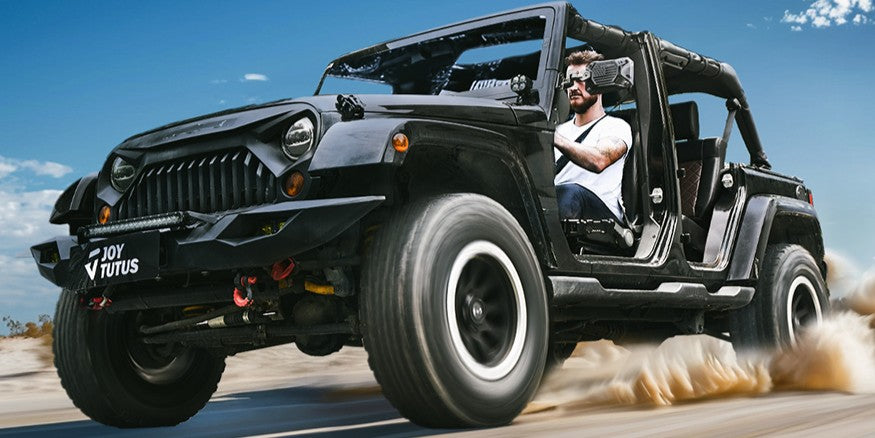
If you've ever searched for replacement accessories and parts, a new set of tires, or a roof rack for your Jeep, only to find out the package you ordered doesn't fit, you already know the pain of not knowing your exact Wrangler generation. It's one of the most common frustrations among Jeep owners, both new and experienced.
The Jeep Wrangler has been around since 1987 and has gone through four distinct generations, each with its own design, dimensions, and mechanical setup. Buying accessories without knowing which generation you own is like ordering shoes without knowing your size. And with Jeep's 2026 lineup introducing an enhanced door hinge system for even easier open-air freedom, interest in Wrangler generations and compatibility is growing more than ever.
If you are planning to upgrade your Wrangler without knowing too much about them, here's the Jeep Wrangler information you need to learn about:
- How the four Jeep Wrangler generations differ from each other
- Key visual clues to identify your Wrangler model by year
- How to use your VIN number to confirm your generation
- The difference between two-door and four-door Unlimited models
- Where to find the right accessories for your specific Wrangler
Identifying Your Jeep Wrangler Models by Year
Knowing your Jeep Wrangler generation is the starting point for every upgrade, repair, or accessory purchase you'll ever make. Parts and accessories are built to fit specific generations, and swapping between them often leads to wasted money and frustration.
The Wrangler has evolved significantly since its debut in 1987. While every generation carries the same iconic silhouette — removable doors, open-air tops, and a seven-slot grille, the engineering underneath is quite different from one era to the next. Enthusiasts and the Jeep community use two-letter codes like YJ, TJ, JK, and JL to refer to each version, though these codes don't stand for anything specific. They're simply shorthand that has stuck over the decades.
Here's a quick reference of all four main Jeep Wrangler generations at a glance:
|
Generation |
Years |
Key Suspension |
Headlights |
Doors Available |
|
YJ |
1987–1996 |
Leaf spring (front & rear) |
Square |
2-door only |
|
TJ |
1997–2006 |
Coil spring (front & rear) |
Round |
2-door only |
|
JK |
2007–2018 |
Coil spring |
Round |
2-door & 4-door |
|
JL |
2018–present |
Five-link coil spring |
Round |
2-door & 4-door |
The Four Jeep Wrangler Generations Explained
Each generation of the Wrangler brought real and meaningful changes — not just cosmetic refreshes. Here's a breakdown of what makes each one distinct.
YJ — The First Wrangler (1987–1996)
The YJ is where the Wrangler name officially began. Launched in 1987 as a successor to the long-running CJ series, the YJ was designed to be more comfortable and better suited for everyday driving while keeping Jeep's core off-road identity intact.
YJ is the easiest and simplest to identify among the 4 Jeep Wranglers. The most recognizable feature of the YJ is its square headlights, since every Jeep before it had round lights. The YJ also used a leaf-spring suspension setup on both the front and rear axles, which gave it a firm, bouncy ride compared to later generations.
Engine options for the YJ included a 2.5L four-cylinder and the beloved 4.0L inline-six. If you're looking at a Wrangler with square headlights and a somewhat boxy, narrow body, you're almost certainly looking at a YJ.
Key YJ identifiers:
- Square headlights (unique to this generation)
- Narrow body width
- Leaf-spring front and rear suspension
- No four-door option
- Model years 1987 through 1996
TJ — The Classic Fan Favorite (1997–2006)
The TJ arrived in 1997 after a one-year production gap. It brought back the round headlights that Jeep fans had been asking for, making it a retro nod to the Wrangler's heritage. More importantly, Jeep replaced the old leaf-spring front suspension with a coil-spring setup borrowed from the Jeep Grand Cherokee, which transformed the way the Wrangler rode on both pavement and trail.
The TJ is widely considered a sweet spot by the Jeep community. It combines the raw, capable nature of the older generations with enough modern comfort to be used as a daily driver. The 4.0L inline-six engine available in the TJ has earned a reputation for being one of the most reliable engines Jeep ever put in a Wrangler. This generation also introduced the "Unlimited" (LJ) model in 2004, which featured a longer wheelbase for extra cargo room, making it a favorite for overlanders. If you are looking to refresh this classic, check out our selection of Jeep Wrangler TJ off-road parts designed to enhance your travel experience.
Key TJ identifiers:
- Round headlights (returning after the YJ's square units)
- Coil-spring suspension front and rear
- Available with 2.5L four-cylinder or 4.0L inline-six
- Two-door body only
- Introduce the “Unlimited” Model LJ during 2004-2006
- Model years 1997 through 2006
JK — The Mainstream Wrangler (2007–2018)
The JK generation was a complete redesign from the ground up — the first clean-sheet Wrangler since the nameplate launched in 1987. It was bigger, heavier, and more powerful, and it introduced one of the most significant changes in Wrangler history: the four-door Unlimited model.
Before the JK, if you wanted a Wrangler, you got two doors. The JK Unlimited opened the Wrangler up to families and buyers who needed more passenger space without sacrificing off-road ability. The JK became one of the best-selling vehicles in Jeep's lineup, and used examples are still extremely popular today.
Engine options included a 3.8L V6 in early models and a more powerful 3.6L Pentastar V6 from 2012 onward. The JK is also wider and longer than the TJ, so parts are not interchangeable between the two.
Key JK identifiers:
- Wider and longer body than TJ
- More curved windshield and plastic front fenders
- Round headlights with a slightly more modern housing design
- Available in two-door (JK) and four-door Unlimited (JKU) versions
- 3.8L V6 (2007–2011) or 3.6L Pentastar V6 (2012–2018)
- Model years 2007 through 2018
If your Jeep was made between 2007 and 2018, you likely need Jeep Wrangler JK off-road parts to fit the specific mounting points of this wider body style.

JL — The Modern Wrangler (2018–Present)
The JL launched for the 2018 model year and represents the most technologically advanced Wrangler ever built. At first glance, it looks similar to the JK, but the JL brought a long list of improvements: lighter aluminum doors and hood, a more refined interior, an eight-speed automatic transmission option, and a wider range of powertrains than any previous Wrangler.
Engine choices for the JL include the 3.6L Pentastar V6, a 2.0L turbocharged four-cylinder with a mild-hybrid system, a 3.0L EcoDiesel V6, a 6.4L V8 HEMI in the Wrangler 392, and the plug-in hybrid Wrangler 4xe. This variety means the JL can serve very different types of drivers — from weekend trail riders to long-distance overlanders.
The 2026 JL introduced an updated door hinge system, making door removal faster and easier than ever. You can choose the right Jeep Wrangler JL off-road accessories, like doors-off mirrors, after removing them. If you're buying a used Wrangler made in 2018 or later, you have a JL.

Key JL identifiers:
- Cleaner, more modern exterior styling compared to JK
- Aluminum hood and doors (lighter weight)
- "Kink" in the grille slats, pull-handle door openers
- Multiple powertrain options including diesel and hybrid
- A standard backup camera mounted in the center of the spare tire
- Model years 2018 to present
If you are not sure whether you owned a Wrangler JK or JL, see our guide Jeep Wrangler JK vs. JL.
Key Difference Between Jeep Wrangler Models
While years and headlights are great indicators, several smaller details help enthusiasts understand the technical difference between Jeep Wrangler models. These differences often dictate whether a specific bumper, rack, or interior accessory will latch correctly.
Experienced Jeep owners look at the "fine print" of the vehicle's body to distinguish between generations that might otherwise look similar at a distance. Here are the most common indicators:
- Door Handles: YJ and TJ models typically have flat, paddle-style handles or push-button handles. The JK has a prominent push-button, while the JL moved to a modern pull-style handle.
- Fuel Filler: On older models (YJ and TJ), the gas cap is often exposed. On the JK and JL, it is usually tucked behind a fuel door or has a more integrated look on the driver’s side.
- Windshield Rests: Look at the hood; the rubber bumps (bump stops) where the windshield rests when folded down are spaced differently on JK and JL models.
- Dashboard Layout: The JL features a much more "vertical" and painted dash compared to the more plastic-heavy, rounded dash of the late-model JK.
How to Use Your VIN to Identify Your Jeep
If you are still unsure about your vehicle’s history, the Vehicle Identification Number (VIN) is the most accurate tool available to you. This 17-digit code is essentially your car's DNA, containing information about the engine, trim level, and assembly plant.
You can find the VIN on the driver's side dashboard (visible through the windshield) or on the sticker inside the driver's side door jam. For Jeep owners, the 10th character is the most important as it represents the model year. For example, a "V" represents 1997 (the start of the TJ), while a "J" represents 2018 (the transition year to JL). Using a free online VIN decoder can tell you the exact sub-model, such as a Sport, Sahara, or Rubicon, which is helpful when buying trim-specific accessories.
Two-Door vs. Four-Door — Understanding the "Unlimited" Label
A common point of confusion, especially among newer Jeep owners, is the "Unlimited" badge. This simply means the four-door version. Jeep introduced the four-door Wrangler Unlimited with the JK generation in 2007, and it continued with the JL.
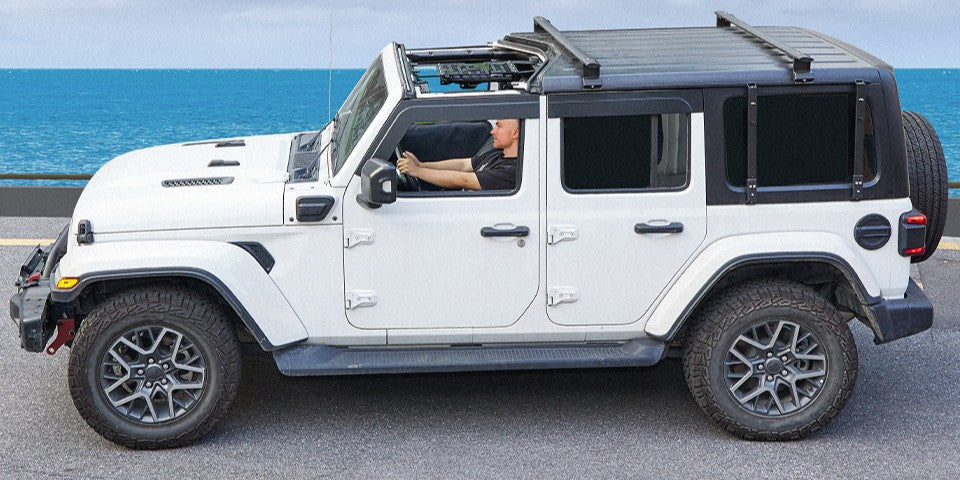
So when you see "JKU" or "JLU," the "U" stands for Unlimited, meaning you're looking at a four-door Wrangler. The standard two-door versions are just called JK or JL. This matters a lot when buying accessories, since roof racks, running boards, and cargo liners are sized differently for two-door and four-door models.
Finding the Best Accessories for Your Specific Wrangler Generation
Once you have identified your Jeep, the real fun begins: upgrading your vehicle to suit your travel needs. At JOYTUTUS, we specialize in products that make your off-road experience safer and more organized.
Choosing the right accessories requires a logical approach to ensure compatibility and durability. When browsing for parts, always follow these three steps:
- Verify your generation: Use the year and headlight shape to confirm if you are YJ, TJ, JK, or JL.
- Check your trim level: Some accessories, like fender flares or interior storage, might differ between a base Sport and a luxury Sahara.
- Prioritize quality: Choose products designed by experts who understand the rigors of automotive travel.
Final Thoughts
Figuring out which Jeep Wrangler generation you own is the first and most important step before buying any accessory or planning any upgrade. Start with the headlights: "square" means YJ, and "round" narrows it down to TJ, JK, or JL. From there, check the door hinges, the body size, and the overall shape of the grille and headlight housings. If you still want to be certain, pull your VIN and decode it online in seconds. Once you know your generation, the world of Jeep Wrangler modifications opens up in a way that is both organized and genuinely fun. Whether you drive a classic TJ, a family-friendly JKU, or a modern JL 4xe, JOYTUTUS has the accessories built to help you get more out of every mile.

Leave a comment
All comments are moderated before being published.
This site is protected by hCaptcha and the hCaptcha Privacy Policy and Terms of Service apply.