

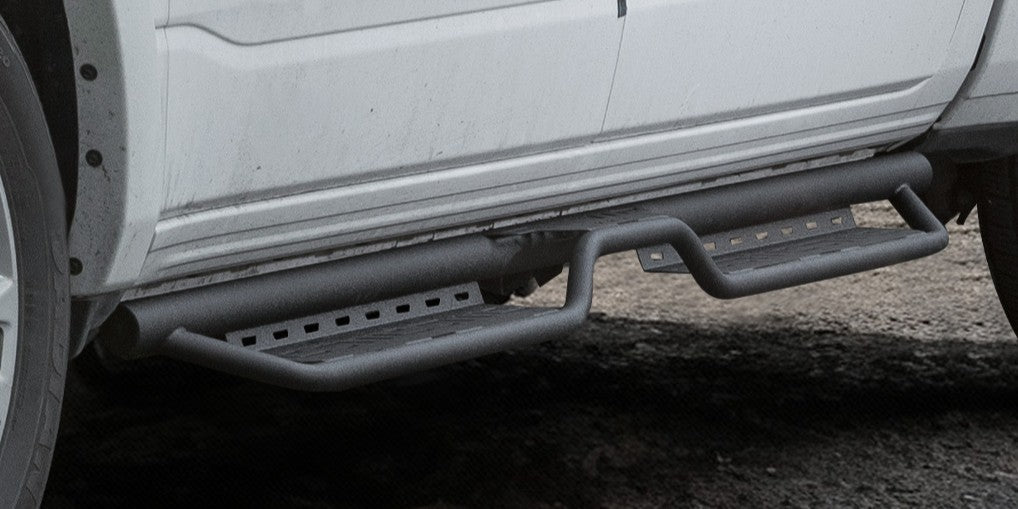
Ford's F-250 Super Duty has become a common pick for owners who need real towing and payload numbers for work, whether that means hauling a trailer, running a job site truck, or building out a rig for overlanding. A recent look at the truck accessories market found that running board and step bar sales grew by more than 20 percent in the past year, as more truck and SUV owners look for an easier, safer way to get in and out of taller vehicles. The F250 sits noticeably higher than a half ton truck, and that extra ride height makes daily entry harder on kids, older passengers, and anyone climbing in with a bag of tools. This guide covers what to know before buying F250 running boards, including the types on the market, the features that actually matter, and how to match a set to your truck's exact cab and bed setup.
Here is what this guide covers:
- The main types of F250 running boards available today
- Which features separate a durable set from a flimsy one
- The best running board style for work, family, and off-road use
- How fitment changes across F250 cab and bed configurations
- A simple process for choosing the right F250 side steps
Types of F250 Running Boards to Choose From
Before comparing brands or prices, it helps to know the basic styles of F250 running boards on the market, since each one is built for a different kind of driving.
Full-Width Running Boards
Full-width running boards run the length of the cab and give you one continuous flat platform to step on. This style works well for anyone who regularly loads kids, coworkers, or older family members into a Super Duty, since the wide surface leaves plenty of room for a full foot placement. Many full-width boards also use a dual-tier design, with a lower step and a slightly raised inner step, which shortens the climb into the cab even further.

F250 Side Steps (Nerf Bars)
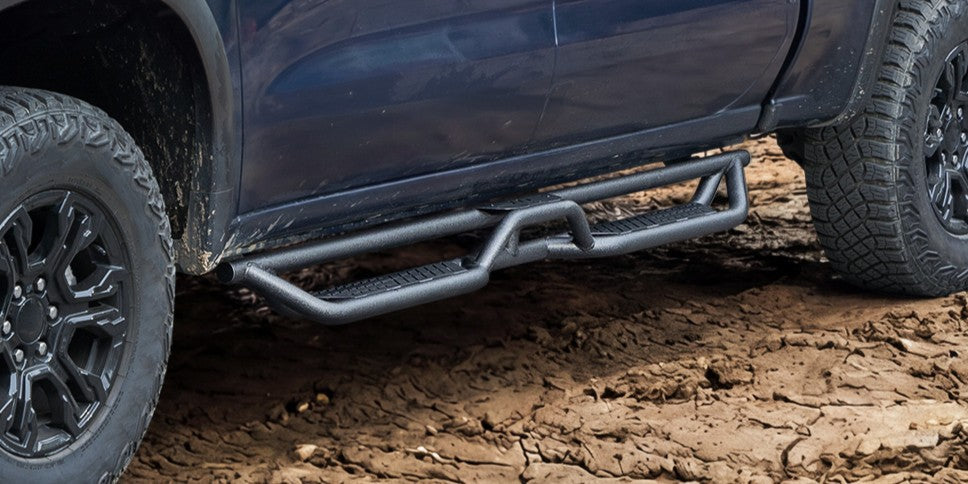
F250 side steps, sometimes called nerf bars, are narrower tube style steps that sit closer to the rocker panel. Instead of one flat surface, they use individual step pads positioned under each door. Side steps tend to be lighter, preserve more ground clearance, and give the truck a more aggressive, off-road look. Drivers who spend time on trails or in deep mud often prefer F250 side steps for this reason, though the narrower pad takes a bit more getting used to for passengers.
Power (Retractable) Running Boards
Power running boards extend automatically when a door opens and tuck back underneath the truck when it closes. They combine the step surface of a full-width board with the clearance benefits of having nothing hanging below the rocker panel most of the time. This style costs more and adds moving parts, so it makes the most sense for owners who want a factory-looking finish and are willing to pay for the convenience.
Key Features of a Good F250 Running Board
Not every set of F250 running boards is built to the same standard, so it is worth knowing what separates a board that lasts from one that loosens up or rusts within a season.
A good set should include the following:
- A load rating that fits real use. Look for a per step capacity of at least 300 to 500 pounds, since Super Duty owners often use the step for gear and tools, not just entry.
- Rust-resistant construction. Carbon steel or aluminum with a multi layer coating, such as electrocoating plus a textured topcoat, holds up far better against road salt and mud than a single coat of paint.
- A textured, non-slip step surface. Wet boots and winter weather make grip a safety issue, not just a comfort one.
- Bolt-on installation with no drilling. F250 running boards that use factory mounting points install faster and avoid weakening the frame or voiding any factory undercoating warranty.
- A width that matches how you use the truck. Wider, full-width boards suit families and passengers, while narrower F250 side steps suit drivers who care more about clearance and looks.
Best F250 Running Boards for Different Use Cases
The right running board depends less on brand and more on how the truck gets used day to day. The table below breaks down a few common scenarios.
|
Use Case |
Recommended Style |
Why It Works |
|
Work truck or fleet vehicle |
Full-width running board |
Wide, flat platform handles frequent in and out trips and holds up to work boots and tools |
|
Family truck with kids or older passengers |
Dual-tier full-width board |
Lower step height and a stable, wide surface make entry easier for every passenger |
|
Off-road or overlanding builds |
F250 side steps (nerf bars) |
Narrower profile preserves ground clearance and matches a rugged build |
|
Lifted Super Duty with a tow package |
Dual-tier board or power running board |
Extra step height bridges the larger gap created by a lift or bigger tires |
Owners cross-shopping other Ford trucks will notice the same logic applies across the lineup. The Ford running boards guide and the F150 running boards guide both walk through similar use case breakdowns if you are comparing more than one Ford model.
F250 Running Board Fitment by Cab and Bed Style
F250 running boards are not one size fits all. The Super Duty comes in a few different cab lengths, and board length has to match the cab to look right and cover the full step area.
|
Cab Style |
Typical Board Length |
Fitment Notes |
|
Regular Cab |
Shortest option, single door per side |
Fewer mounting points, usually the simplest installation |
|
SuperCab (Extended Cab) |
Mid-length, covers front and rear half doors |
Requires brackets sized for the extended door opening |
|
Crew Cab (SuperCrew) |
Longest option, covers four full doors |
Most common configuration for family and work use, needs the most mounting brackets |
Always check the model year range along with cab style before buying, since Ford has changed rocker panel mounting points across Super Duty generations. If you are shopping across the Ford lineup, the fitment principles are similar to what is covered in the Bronco running boards, Ford Ranger running boards, and Ford Explorer running boards guides, which is worth a look if your household runs more than one Ford.
How to Choose F250 Running Boards for Your Truck
Picking the right F250 running boards comes down to a short list of decisions rather than a long research project.
- Confirm your cab and bed configuration first. Regular Cab, SuperCab, and Crew Cab all use different board lengths and bracket kits, so this step narrows your options fast.
- Decide between a full-width board and F250 side steps. Base this on who rides in the truck and whether ground clearance matters more than passenger comfort.
- Check the load rating against real use. If tools, coolers, or gear regularly ride on the step, buy toward the higher end of the capacity range.
- Compare material and finish. Coated carbon steel and aluminum both hold up well, but the coating quality matters more than the base metal.
- Look at the installation requirements. A no-drill, bolt-on kit that uses factory mounting points saves time and keeps the truck's warranty intact. The how to install running boards guide walks through what a typical install looks like from start to finish.
Final Thoughts
Choosing F250 running boards is really a matter of matching the board style to how the truck gets used. A work truck benefits from a wide, flat platform that holds up to boots and tools; a family hauler benefits from a dual-tier design that shortens the step up for smaller or older passengers; and an off-road build benefits from the tighter clearance of F250 side steps. Once you know your cab style, expected load, and preferred look, narrowing down the right set becomes a quick decision rather than a guessing game. For a closer look at current fitment options and finishes, visit JOYTUTUS and browse the running boards collection for your SUVs and trucks.
FAQs
Q1: Will F250 running boards also fit an F350?
A: Often yes, since the F250 and F350 share the same cab and frame in many model years. Always confirm against the listed year and cab style before ordering, since small differences in trim or lift height can change fitment.
Q2: Do I need to drill holes to install F250 side steps?
A: Most modern kits use factory mounting points along the rocker panel, so drilling is rarely required. A bolt-on kit with pre-aligned holes typically installs in under an hour with basic hand tools.
Q3: How much weight can F250 running boards hold?
A: It depends on the brand and design, but a solid set built for a Super Duty should support at least 300 to 500 pounds per step, enough for an adult stepping up while carrying gear.


Leave a comment
All comments are moderated before being published.
This site is protected by hCaptcha and the hCaptcha Privacy Policy and Terms of Service apply.