

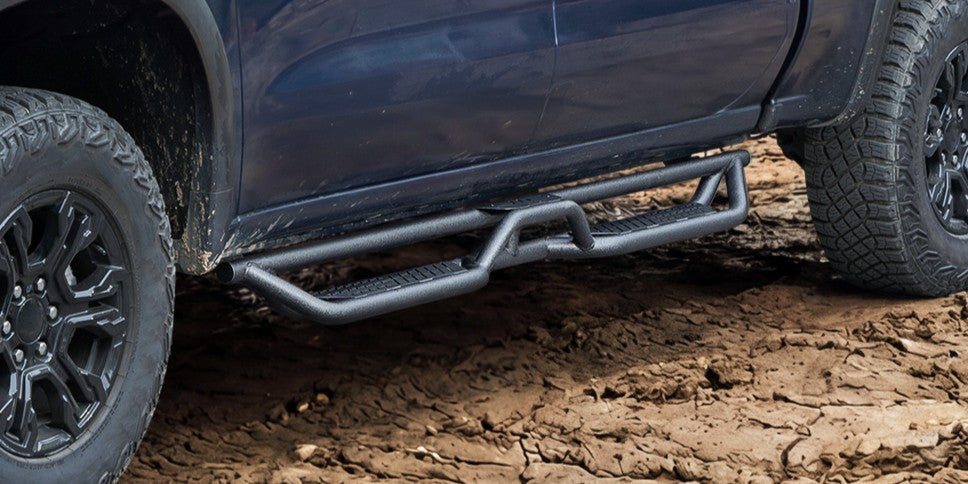
The Ford F-150 keeps its spot as the best selling truck in America, and F-Series sales topped 357,801 units through the first half of 2026 alone. That kind of volume means a lot of new owners, and many of them are asking the same question soon after they drive off the lot: how do I make it easier to climb in and out of this truck?
That question gets more common every year, since F150s sit higher than ever thanks to larger tires, factory 4x4 packages, and popular lift kits. A set of F150 running boards solves the problem, but only if it fits your specific cab. This guide walks through everything an F150 owner needs to know before buying F150 side steps, from cab sizes to materials to shopping picks for each configuration.
This guide breaks down everything an F150 owner needs to know before buying. Here is what we will cover:
- Why F150 owners add running boards in the first place
- The main styles, materials, and mounting types available
- Fitment differences between SuperCrew, SuperCab, and Regular Cab
- A simple checklist for choosing the right F150 side steps
- Installation basics and where to find fitment-specific guides
Why F150 Owners Add Running Boards
Running boards are not just a look. They solve a daily, physical problem for anyone who drives a tall truck.
A flat, wide running board gives you and your passengers a stable place to step, which matters most for kids, older family members, or anyone climbing in with hands full. Beyond that, F150 running boards shield your rocker panels and lower doors from mud, gravel, and road salt, which helps slow down rust and keeps your paint looking newer for longer. For families hauling kids to practice or work trucks loading tools every morning, that mix of safer entry and body protection is usually what pushes owners to buy a set.
If you are cross-shopping other Ford models, the JOYTUTUS Ford running boards guide compares fitment across the F-150, Bronco, Ranger, F-250, and Explorer lineup. It is a useful starting point if F150 running boards are only one of several options on your list.
Types of F150 Running Boards Explained
Before comparing fitment by cab size, it helps to understand the main styles on the market, since each one trades off differently between price, looks, and function.
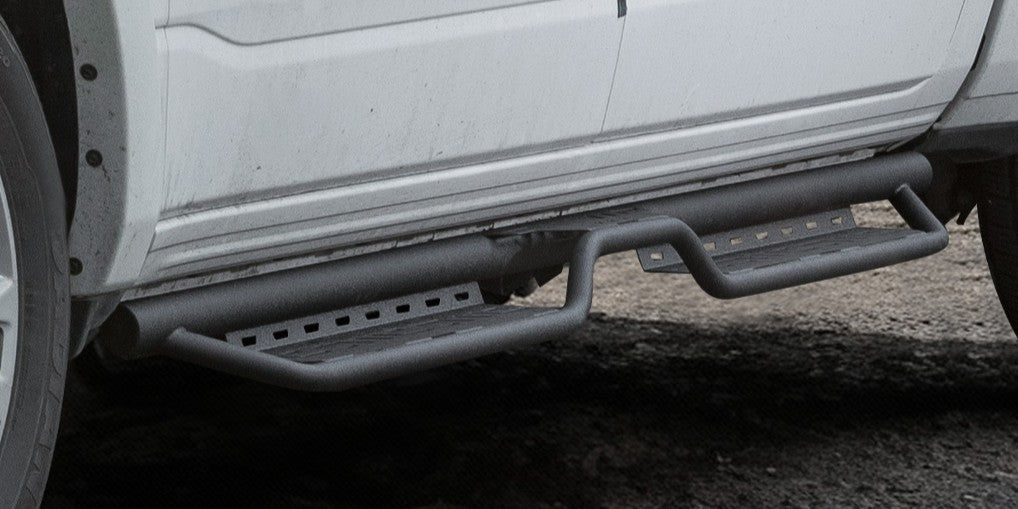
Most F150 running boards fall into one of three broad categories. Fixed running boards stay in place at all times and are simple, affordable, and require no wiring, which makes them the most common choice for daily drivers and work trucks. Power running boards extend automatically when a door opens and retract when it closes, keeping ground clearance high while parked or driving off-road, though they cost more and involve a slightly more complex install. Side steps and nerf bars use a narrower, tubular design instead of a full flat platform, which trims weight and gives the truck a rugged, off-road inspired look.
Material choice matters just as much as style. Carbon steel is strong and budget friendly but needs a good coating to resist rust over time. Aluminum is lighter and naturally corrosion resistant, which is why it appears on many mid-range boards. Stainless steel sits at the premium end, offering the best corrosion resistance along with a polished, upscale look.
|
Feature |
Fixed Running Boards |
Power Running Boards |
Side Steps / Nerf Bars |
|
Typical price range |
Budget friendly |
Higher cost |
Budget friendly |
|
Installation |
Simple bolt-on |
Bolt-on plus wiring |
Simple bolt-on |
|
Ground clearance |
Slightly reduced |
Full clearance when retracted |
Minimal impact |
|
Step surface width |
Wide |
Wide |
Narrow |
|
Best for |
Daily drivers, families |
Lifted trucks, mixed use |
Off-road builds |
F150 Running Boards Fitment by Cab Style
The F150 comes in three cab configurations, Regular Cab, SuperCab, and SuperCrew, and each one uses a different board length. Getting this right is the single most important step before you order, since a board built for the wrong cab will either leave a gap at one door or hang too far past the last one.
Running Boards for Ford F150 SuperCrew
The SuperCrew is the most popular F-150 configuration on the road, thanks to its four full size doors and generous rear seat room. That popularity is exactly why running boards for Ford F150 SuperCrew models are in such high demand. Because the SuperCrew has four doors to cover, owners typically want a full-length, cab-length board that reaches every entry point without gaps. A wide, textured step surface is worth prioritizing here, since SuperCrew owners are more likely to be loading kids or passengers into the back seat on a regular basis.
Weight capacity is another detail worth checking for this configuration. Most running boards on the market are rated between 300 and 500 pounds per side, and it is worth confirming that number against how many people or how much gear you typically load through the rear doors.
Running Boards for Ford F150 SuperCab
The SuperCab, sometimes called the extended cab, has two smaller rear-hinged doors in addition to the front doors. Running boards for this cab style need to account for the shorter rear door and the slightly different step spacing that comes with it. A cab-length board still works well here, but confirming the exact door count and hinge style before ordering helps avoid returns.
SuperCab owners who mostly use the rear doors for occasional passengers or storage access can often get by with a narrower board than a SuperCrew owner would choose, since the rear seats see less daily traffic.
Running Boards for Ford F150 Regular Cab
The Regular Cab is the simplest configuration, with just two doors and no rear seating area. Running boards here are shorter and typically less expensive, since they only need to cover the front door on each side. Work truck owners tend to favor this setup, often pairing a narrower side step or nerf bar style board with a frame mounted design for extra durability under repeated use.
How to Choose the Right F150 Side Steps
With so many options on the market, it helps to narrow the decision down to a short checklist before you buy.
- Confirm your exact cab size, SuperCrew, SuperCab, or Regular Cab, before ordering, since board length is not interchangeable.
- Decide between fixed, power, or side step styles based on your budget and how you use the truck.
- Match weight capacity to your actual use, especially if you regularly load passengers or gear through the rear doors.
- Choose a material and finish suited to your climate, particularly if you deal with road salt or heavy rain.
- Consider ground clearance if you drive off-road or on rough terrain regularly.
- Check whether the kit uses factory mounting points, since that usually means no drilling is required.

When it comes to running boards, F150 owners get the best results by shopping fitment first and style second.
Installation and Care Basics
Once you have settled on the right style and fitment, installation is usually the easy part. Most F150 running board kits use factory mounting points, so drilling is rarely required, and a set can typically go on in under an hour with basic hand tools such as a socket set and a torque wrench.
After installation, a quick rinse to clear off mud and road salt, along with an occasional check of the mounting bolts, will keep most boards performing well for years. For a full walkthrough of the process, our running board installation guide is worth reading before your parts arrive.
More Ford Running Board Guides
If you drive more than one Ford or you are cross-shopping against a different model, JOYTUTUS also publishes fitment guides for other popular Ford vehicles, including the Bronco, the Ford Ranger, the F250, and the Ford Explorer. For a side by side comparison across the whole Ford lineup, see the general Ford running boards guide.
Conclusion
Choosing the right F150 running boards comes down to matching the product to your cab size and how you actually use your truck. SuperCrew owners generally want a full length, wide board that handles daily passenger loading, SuperCab owners should confirm door spacing before ordering, and Regular Cab owners can often go with a shorter, more work-focused setup. Whichever cab you drive, checking cab size, weight capacity, and finish before you buy will save you a return and get you a set of F150 side steps that fits right the first time. JOYTUTUS is committed to providing automotive travel products that keep every trip safe and enjoyable, and you can explore the full range at JOYTUTUS to find the running boards built for your truck.

Leave a comment
All comments are moderated before being published.
This site is protected by hCaptcha and the hCaptcha Privacy Policy and Terms of Service apply.